Your Memory Is Not a Business SystemWhat Pet-Care Owners Should Put in Writing
Growing pet-care businesses stall when too much operational knowledge lives only in the owner's head. A practical guide to the policies, processes, templates, and systems worth putting in writing.
By Katie Pape, VP of Operations7 min read · September 15, 2026
When I started Windy City Paws, many of our processes were not really processes yet. They were simply the way I did things.
I knew how to respond to a concerned client, determine whether we could accommodate a scheduling request, address a performance issue, or prepare the team for a busy holiday. For a while, that worked because I was involved in almost everything.
As the company grew, though, so did the number of decisions that depended on me. Team members needed answers. Managers needed guidance. Clients expected a consistent experience regardless of who handled their request.
The problem was not that our employees were incapable. It was that too much of what they needed to know still lived in my head.
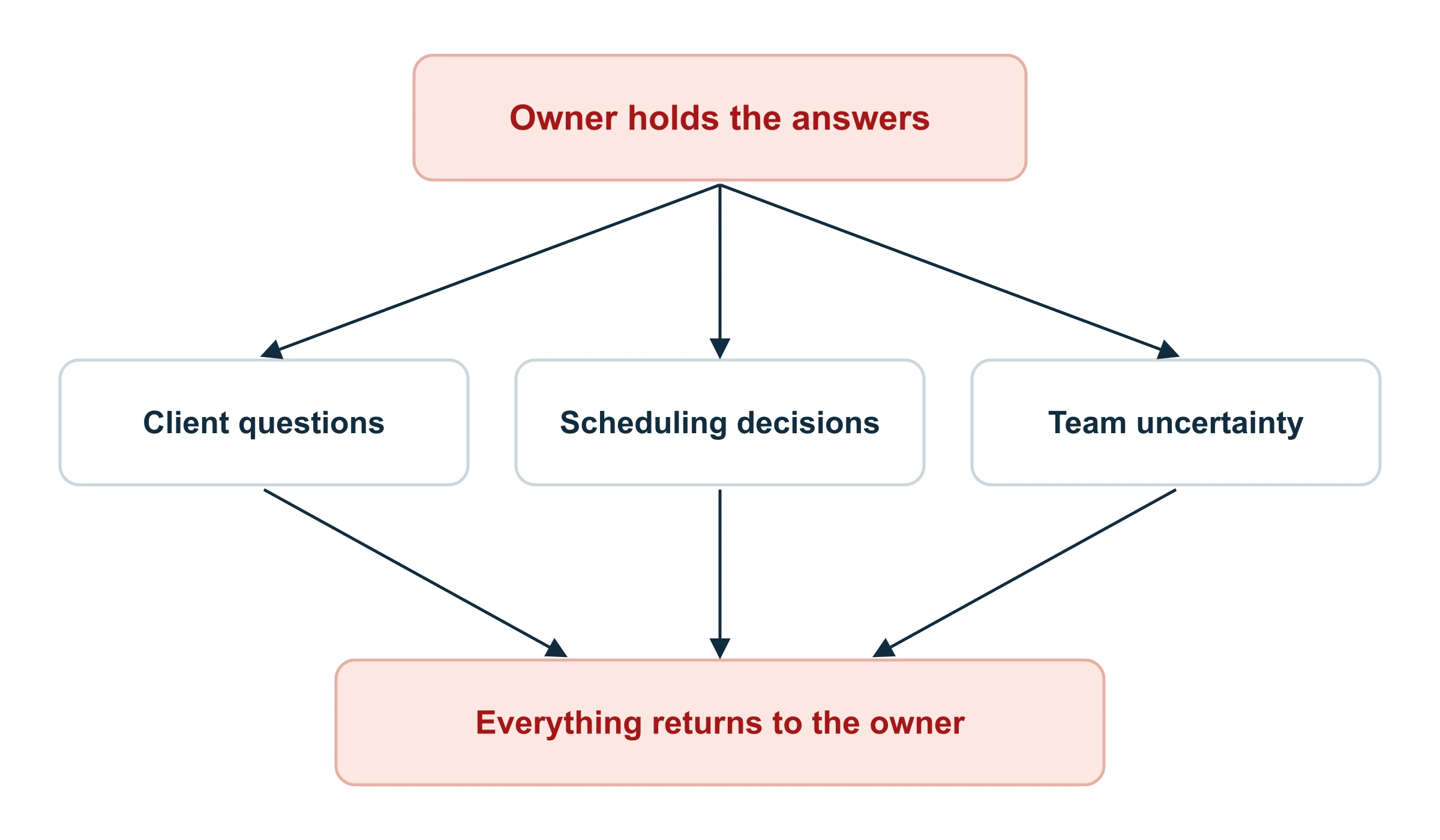
When the knowledge lives only in the owner’s head, every routine decision routes back through one person.
As the company grew, though, it became harder for everyone to provide a consistent experience when so much of that knowledge still lived in my head.
This is a common stage for growing pet-care businesses. An owner develops years of valuable knowledge, but employees may only learn it through conversations, observation, and trial and error. Even strong team members can make different decisions when the company’s expectations have never been clearly documented.
Putting the right information in writing creates greater consistency for employees, clients, and the pets in your care. It can also reduce the number of routine questions that require the owner’s involvement.
That does not mean you need to create a hundred-page operations manual. The best place to begin is with the information your team uses most often and the situations where inconsistency creates the greatest risk.
Start with policies that protect pets, clients, and employees
Your most important policies should never depend on someone remembering a conversation from six months ago.
Safety procedures are an obvious priority in pet care. Employees should clearly understand expectations involving leashes and safety equipment, accessing client homes, severe weather, pet health concerns, incidents, and emergencies. They should also know exactly whom to contact and how quickly an issue needs to be reported.
Other important policies may include attendance, time-off requests, client cancellations, service arrival windows, key management, privacy, and employee communication expectations.
When writing a policy, explain both the expectation and the reason behind it. Employees are more likely to follow a policy consistently when they understand the problem it is intended to prevent.
Document the processes your team repeats
If your employees regularly ask how to complete the same task, that is usually a sign that the process should be documented.
Start by considering the responsibilities your team handles every day, week, month, and year. In a pet-care business, those might include:
Responding to prospective client inquiries
Scheduling Meet & Greets
Matching walkers or sitters to clients
Managing recurring and on-demand schedules
Confirming holiday availability
Handling cancellations
Reviewing time or payroll information
Following up on client concerns
Hiring and onboarding new team members
Completing employee reviews
You do not need to document every possible scenario immediately. Focus first on processes that happen frequently, affect the client experience, involve multiple employees, or create a significant problem when a step is missed.
The documentation itself should be straightforward. Identify who owns the process, when it needs to happen, which system should be used, and what a completed outcome looks like.
Create templates for common client communications
Pet-care teams often send similar messages repeatedly. Templates can save time and help ensure that important information is communicated clearly.
Useful templates might include:
Responding to a prospective client inquiry
Introducing a new walker or sitter
Communicating a scheduling change
Explaining a cancellation charge
Responding to a service concern
Requesting a client review
Reminding clients about holiday scheduling
A template should be a starting point, not a script that removes all personality from the interaction. Encourage employees to personalize the message with the client’s name, the pet’s name, and details relevant to the situation.
The goal is to make communication more consistent without making it feel like it came from a mass-email campaign.
Clarify who is responsible for what
Written instructions alone will not solve an unclear division of responsibility. Employees also need to understand who owns each area of the business and what authority comes with that responsibility.
When ownership is unclear, important tasks can be duplicated, delayed, or missed altogether. Even a capable manager may continue bringing routine decisions to the owner if no one has clarified what the manager is authorized to handle independently.
For important responsibilities, your team should know:
Who owns the task
What that person can decide independently
When another team member or manager should be involved
Which situations need to be escalated to the owner
This creates accountability while giving employees the clarity and confidence to act.
Give everything one reliable home
Even excellent documentation is not helpful if no one knows where it is.
If policies are buried in email threads, templates live on someone’s laptop, training materials are scattered across shared folders, and procedures exist in multiple versions, employees will often default to the same solution: asking the owner.
Choose one primary location for policies, processes, templates, and training materials. Organize the information in a way that makes sense to the people who use it, and include links to any related forms, systems, or resources.
At Houndry, we use Trello because it allows us to organize operational information visually and gives team members a clear place to find what they need. Other businesses might use Notion, an internal wiki, or a different shared system.
The specific platform matters less than whether employees know where to go, can navigate it easily, and trust that the information is current.
Avoid saving multiple versions of the same document in different places. If employees are unsure which version is current, they may return to asking the owner rather than relying on the written guidance.
New employees should be introduced to these resources during training. Existing employees may also need reminders about where information is located and when they are expected to reference it.
A well-organized resource becomes more valuable when using it is part of the team’s everyday work, not something employees only reference when a problem occurs.
Review what you create
Pet-care businesses change. Services evolve, software changes, new policies are introduced, and teams discover better ways to handle recurring challenges.
Assign someone to review important documentation periodically. Employees should also have a clear way to flag instructions that are outdated, incomplete, or inconsistent with how the work is actually being done.
Your team’s questions can provide useful feedback. If employees continue asking about something you believe has already been documented, consider whether the instructions are unclear, difficult to find, or missing an important exception.
Documentation should support the operation of the business, not become an administrative project that is completed once and forgotten.
Begin with what creates the most confusion
Creating written systems can feel overwhelming, especially when an owner has been operating the business successfully for years without them. You do not need to document everything at once.
Start with one recurring area of confusion. Write down the current expectation, determine who owns it, clarify what decisions that person can make, and place the information somewhere the team can easily access it. Then move to the next issue.
Over time, these small improvements can reduce misunderstandings, help managers become more confident, and create a more consistent experience for clients and employees.
They also give an owner greater flexibility. Clearer operations can support continued growth, make it easier to add management, or help prepare the business for an eventual transition.
At Houndry, we have learned that the strongest systems do more than make a business efficient. They help preserve the quality of care, trusted relationships, and company culture that an owner worked so hard to build.
The goal is not to remove the owner’s experience from the business. It is to make sure that experience can guide the entire team, even when the owner is not there to answer every question.
Katie founded Windy City Paws in Chicago and, after its acquisition, joined Houndry's leadership team. As VP of Operations, she works closely with managers and leaders across Houndry's brands, bringing both an owner's perspective and an operator's experience to the role.
Newsletter
Guidance for your next chapter, in your inbox.
Practical, no-pressure insights on growing, valuing, and selling a pet-care business. A couple of emails a month, and you can unsubscribe anytime.
Thanks for subscribing. Check your inbox to confirm your email.
Let's talk
Thinking about the systems behind your next chapter?
Whether you're scaling, adding management, or simply getting more out of your head and onto paper, we're happy to share what has worked across our brands.