
← All articles

Is Your Business Ready for Growth or Sale?

Preparing your pet-care business for growth or a sale comes down to the same fundamentals. Here's a checklist to get ready, and why timing matters.

A pet-care business owner looking out over their storefront at golden hour

Whether your goal is to grow your business or eventually sell it, the preparation is surprisingly similar. I’ve done both, and it always comes back to the same foundation: understanding your business well enough that it can run smoothly without you.

Both paths require you to fully understand your business, your key metrics, and where things stand today. You should be able to track trends year over year, including revenue growth, customer retention, and operational efficiency, because all of them shape your scalability and your value to a buyer. Whether you plan to scale or sell, well-defined processes and policies are essential. A business that runs smoothly, with minimal day-to-day owner involvement, is not only more valuable but also easier to manage and grow.

If you are thinking about selling, timing matters more than most owners expect. The best time to sell is when your business is thriving, not when you are facing challenges. Selling during a period of stability and growth, when revenue is strong, operations are smooth, and the team is happy, is the best way to maximize value and ensure a clean transition. Trying to sell during hard times, whether it is declining sales, the loss of key staff, or a personal emergency, can significantly reduce your appeal to buyers. Buyers are looking for opportunities, not obstacles.

By preparing early, whether you plan to sell soon or years down the road, you put yourself in a position to secure the best possible outcome.
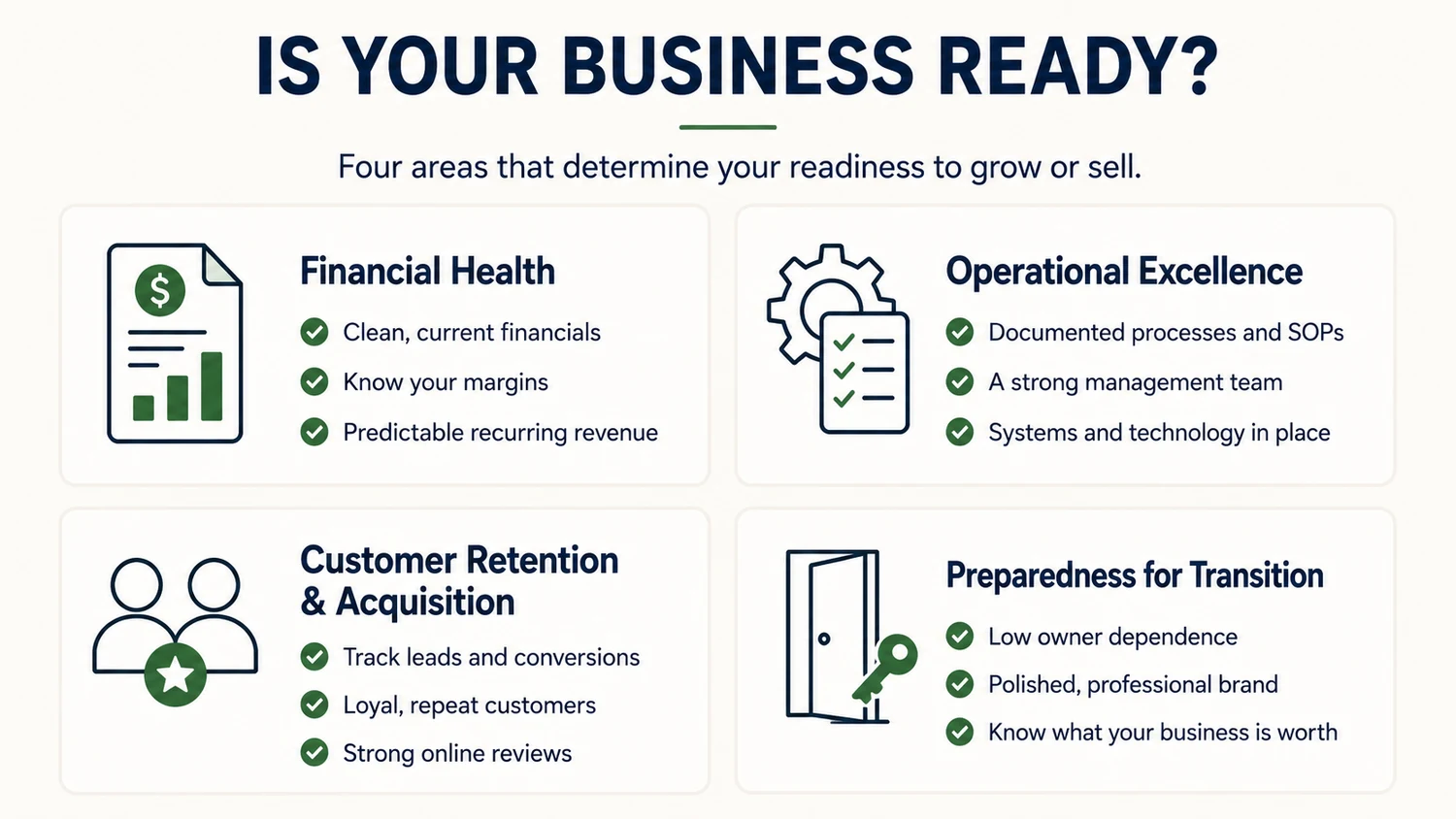
Checklist for Success

Is your business ready? Four areas determine your readiness to grow or sell. Financial Health: clean, current financials; know your margins; predictable recurring revenue. Operational Excellence: documented processes and SOPs; a strong management team; systems and technology in place. Customer Retention and Acquisition: track leads and conversions; loyal, repeat customers; strong online reviews. Preparedness for Transition: low owner dependence; a polished, professional brand; knowing what your business is worth.

1. Financial Health

  • Accurate, organized financials: Ensure your profit and loss statement, balance sheet, and cash flow statements are up-to-date and easy to understand. Buyers (and you) need a clear financial picture to make decisions.
  • Understand your margins: Know your profit margins by service type. Highlight and focus growth on higher-margin services to increase value and profitability.
  • Track recurring revenue: Show predictable, consistent income streams. Businesses relying heavily on one-time transactions are seen as riskier.

2. Operational Excellence

  • Document your processes: Have clear Standard Operating Procedures (SOPs) for key tasks such as scheduling, client communication, payroll, and billing. Whether you’re scaling or selling, SOPs are essential for transitioning responsibilities to employees, allowing you to spend more time working on the business rather than in it.
  • Strong management team: Delegate responsibilities to managers or team leads who can handle day-to-day operations. Buyers prioritize businesses with strong, capable teams, and investing in dedicated managers not only makes your business more attractive but also positions it for continued growth.
  • Service area optimization: For dog-walking businesses, build density within your service areas. Reducing inefficiencies improves margins and simplifies operations.
  • Leverage technology: Use tools like Time to Pet for scheduling, reporting, and team management. Efficient systems make transitions seamless and reduce buyer risk.
  • Employee culture: Cultivate a strong workplace culture that employees enjoy and value. A positive culture not only improves employee retention and tenure but also drives operational excellence, making your business more attractive to both buyers and customers.

3. Customer Retention & Acquisition

  • Track new leads and client conversions: Understand where your new clients are coming from, track conversion rates, and analyze which clients were won or lost and why. This data is invaluable for both growth and sale readiness.
  • Build a loyal customer base: Focus on retaining existing clients through great service and consistent communication. High retention rates signal stability to potential buyers.
  • Maintain positive online reviews: A strong online reputation boosts your value. Actively encourage happy clients to leave reviews on platforms like Google or Yelp.

4. Preparedness for Transition

  • Minimize owner dependence: Start transitioning operational tasks to your team to ensure the business can run smoothly without you. Buyers want to see independence.
  • Polished branding: Ensure your website, logo, and marketing materials are professional and up-to-date. A strong brand makes a great first impression.
  • Valuation awareness: Know what your business is worth. Speak with an expert or use valuation tools to understand what buyers may pay or where development is needed to increase the value.

The bottom line

Getting your business ready for sale or growth starts with understanding it inside and out. By focusing on strong financials, clear operations, and sustainable customer acquisition, you build a business that thrives, whether you scale it to new heights or pass it on to a new owner.

Waiting too long to act can quietly cost you, on both the growth side and the sale side. Start preparing today, and you will be ready to move when the time is right.

And if you want to understand how a buyer will actually put a number on all of this, our article on what your small business is really worth breaks down the metrics buyers use and why some businesses earn higher multiples than others.

Josh Stine
About the author

Josh Stine, CEO Houndry

Josh has spent more than two decades in pet care, founding and running his own companies before joining Houndry as a partner in 2018. Today, as CEO, he works with new businesses as they join the platform and helps guide the company's growth, team, and long-term direction.

A Houndry walker and dog on a tree-lined city street at golden hour
Let's talk

Questions about selling your business?

At Houndry, we're always happy to share what we know about pet care and business sales and acquisitions.

Contact us