
What's Your Small Business Really Worth?
Professional buyers ask two questions. Most owners grasp the first, but underestimate how much of their value is tied to the second.

Professional buyers ask two questions. Most owners grasp the first, but underestimate how much of their value is tied to the second.

Two similar businesses each generated $200,000 in profit last year.
One sells for $400,000. The other sells for $600,000.
Just knowing the sale price, most people would assume the second business has higher profits. But that’s not the case. These businesses are in the same industry, the same size, with the same earnings, and even the same market. So why would a buyer pay 50% more for the second one?
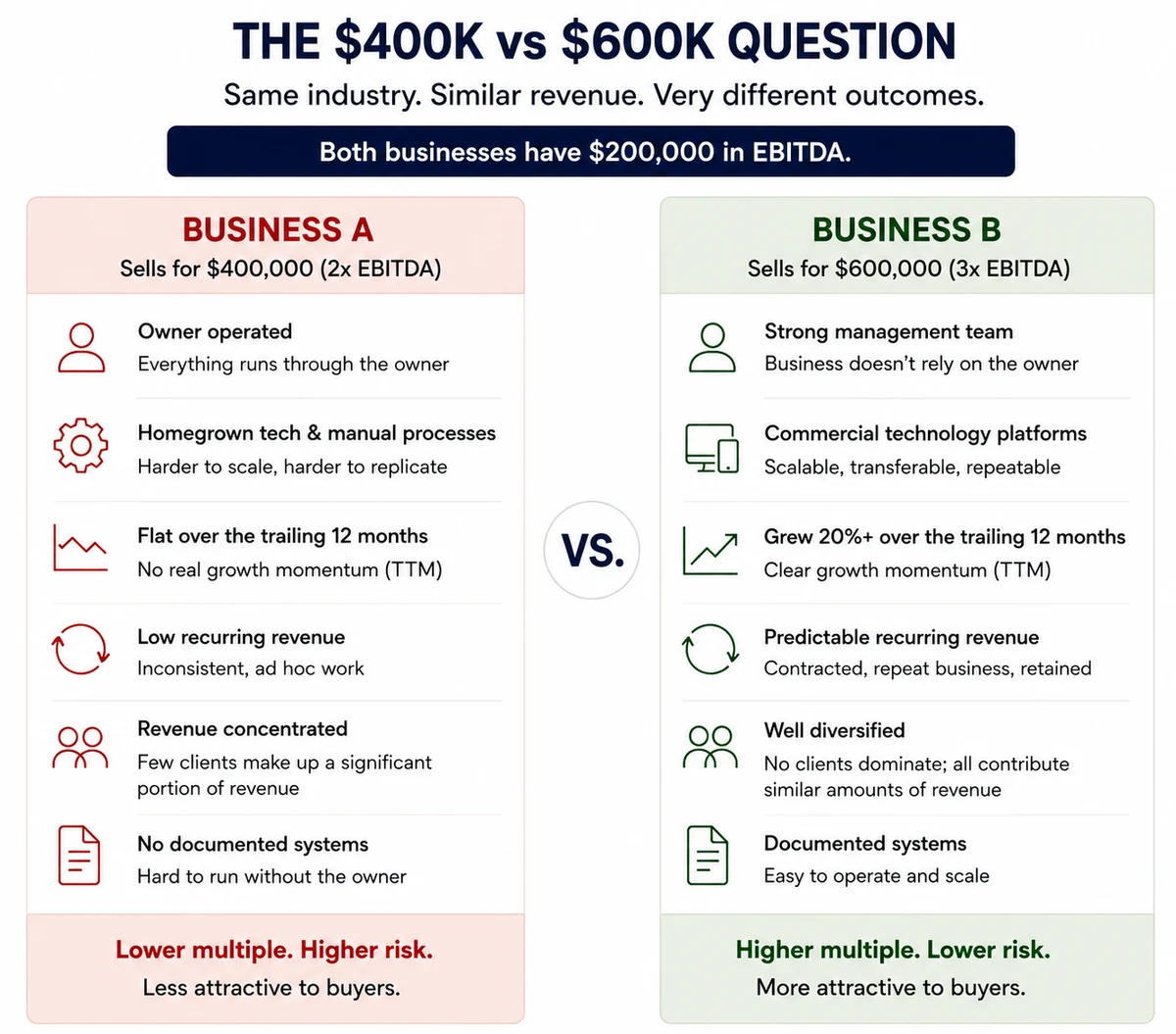
It isn’t luck, or hard negotiating, or one owner outworking the other. The answer lies in how professional buyers think, which differs from how owners do.
Even with a finance degree from NYU, it wasn’t obvious to me how buyers actually valued small businesses beyond profitability, while I was going through the process of selling my first business, Running Paws, in 2014. And at that time, there simply wasn’t much guidance available. Since then, I’ve sold and acquired businesses, and now spend much of my time evaluating them. My experience is in pet care, but the principles below apply to nearly any service business.
Most owners think about what they put in: the years, the nights and weekends, the uncertain cash flow, the skipped paychecks. But none of that is what a buyer is paying for. They’re investing for one reason: they believe the business will provide a return on their investment in the future.
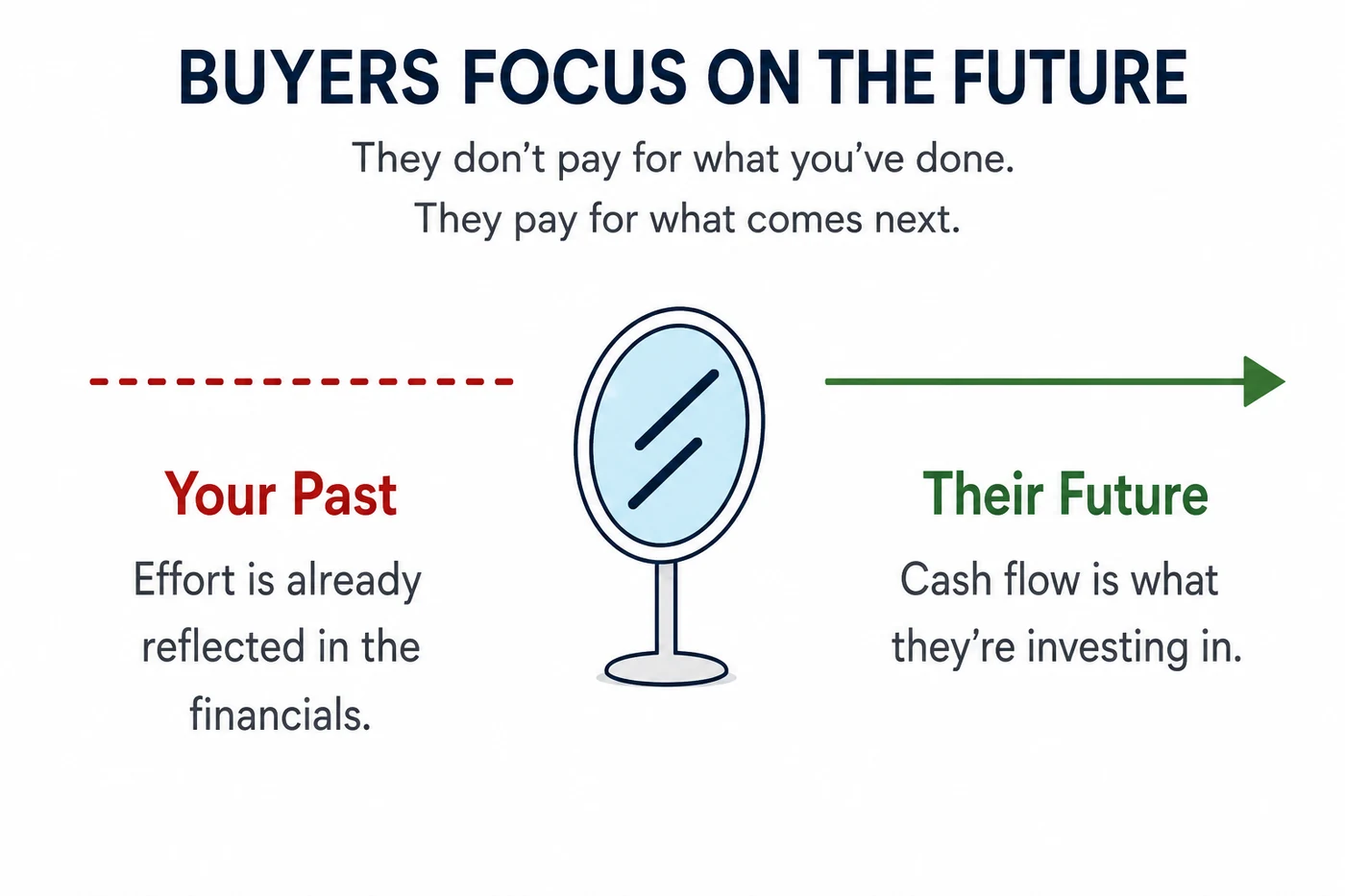
Every question a serious buyer asks is an attempt to determine how confident they are that your business will continue to produce profits once you’re out of the picture.
The first question is: do the economics of this business indicate that it’s worth owning?
The second, and equally important: how confident am I that those economics continue after the current owner leaves?
That’s the model buyers rely on. It isn’t a formula, it’s a way of thinking. Everything else in this article, every metric and every operational detail, fits into one of those two questions. Improve both, and you sell at the top of the range; fall short on either and you sell at the bottom, or not at all.
The first question is easy to understand, but the answer is less obvious. So below, we’ll try to make it as simple as possible.
Economics are the financial engine of the business: how it makes money today, and where those earnings are headed tomorrow. The economics answer the question, “is this business financially attractive enough to own?” But they encompass several things sellers should be aware of; it’s not just revenue and margin.
I hear it all the time, and it’s understandable: owners believe their business’s value is tied to revenue. But revenue on its own isn’t a very useful number. To highlight this, consider two companies each doing $2 million in revenue. They can be worth wildly different amounts if one is turning a healthy profit while the other barely breaks even. Revenue tells you how much activity a business is doing, not whether it’s worth owning.
So buyers first look to profit. Picture two companies: one does $2 million in annual revenue but breaks even, while the other does $600,000 and clears $200,000 in profit. With nothing else to go on, it’s obvious most buyers would be more interested in the “smaller” but more profitable company. Revenue measures activity. Economics tell a buyer whether the business is worth owning.
Once buyers understand the economics of a business, they need a way to measure them. Depending on the size and structure of the company, there are several valuation methods, but for most privately owned service businesses, buyers are usually looking at one of two earnings metrics: EBITDA or Seller’s Discretionary Earnings (SDE).
EBITDA (earnings before interest, taxes, depreciation, and amortization) is the standard for professionally managed businesses. It measures the operating profit generated by the business itself, independent of how it’s financed or who owns it.
Seller’s Discretionary Earnings, or SDE, is more commonly used for smaller owner-operated businesses. It starts with profit and adds back the owner’s salary, discretionary expenses, and certain one-time costs to estimate the total economic benefit currently flowing to a single owner.
Although they’re calculated differently, both metrics are ultimately trying to answer the same question: what is the sustainable economic value of this business?
You’ll also hear about other valuation approaches. Discounted Cash Flow (DCF) is common in larger middle-market and public-company transactions, where future cash flows can be modeled in detail. Revenue multiples are sometimes used for high-growth businesses, particularly software companies with strong growth but little or no current profit. Those methods are generally less relevant for the kind of small service businesses discussed here.
But the engine isn’t only last year’s output. A buyer is buying the future, so they care just as much where earnings are headed, which is why recent performance counts for more than historical performance. Buyers rely on your last three years and trailing twelve months because it’s the best signal of what comes next.
Taken far enough, this is why even a business with modest earnings today can still be valuable. If it’s growing in a strong market with a credible path to increasing profitability, the engine can be compelling before all the profits arrive.
But this is where it’s important to understand that economics reward the future you can demonstrate, not the future you can describe.
“My business has so much potential” may well be true, and most sellers believe it. “A new owner could add services, expand the area, or launch a subscription to grow the business,” and any of it might be completely real. But when I hear these things, I have to wonder: if it were that easy, why hasn’t the current owner already done it? They know the business better than anyone, and they’ve been at it for years. Simply put, buyers don’t pay for maybes and unexecuted ideas.
I’ve also heard, “My brand, or my logo, is worth more than you’re crediting it for.” But the reality is that a valuable brand is already reflected in the numbers.
But economics alone don’t set the price, which is why two businesses with the same earnings can sell for very different amounts. A great engine is only worth paying for if the buyer believes it will still be running after you leave. That’s the second question.
Call it buyer confidence. It gets at what every buyer is quietly nervous about: will these economics still exist once I’ve written the check and I own the business?
Risk is what raises or lowers that confidence. Think of a credit score. Two people borrow the same amount, but the higher score gets a lower rate and better terms, not because the lender likes them more, but because they’re more confident of being repaid. A business is the same: the more confident a buyer is that your earnings hold up after closing, the higher the multiple they’ll pay on the same economics.
That confidence comes down to a familiar set of questions:
Every “yes” increases confidence.
Which brings us back to our two businesses: just two different stacks of answers. The one that sold for $600,000 is mostly yes: it runs without the owner, its revenue recurs, its books are clear, no single client could sink it. The one that sold for $400,000 is mostly no. Same economics, very different confidence, and that gap is the entire 50% difference in price.
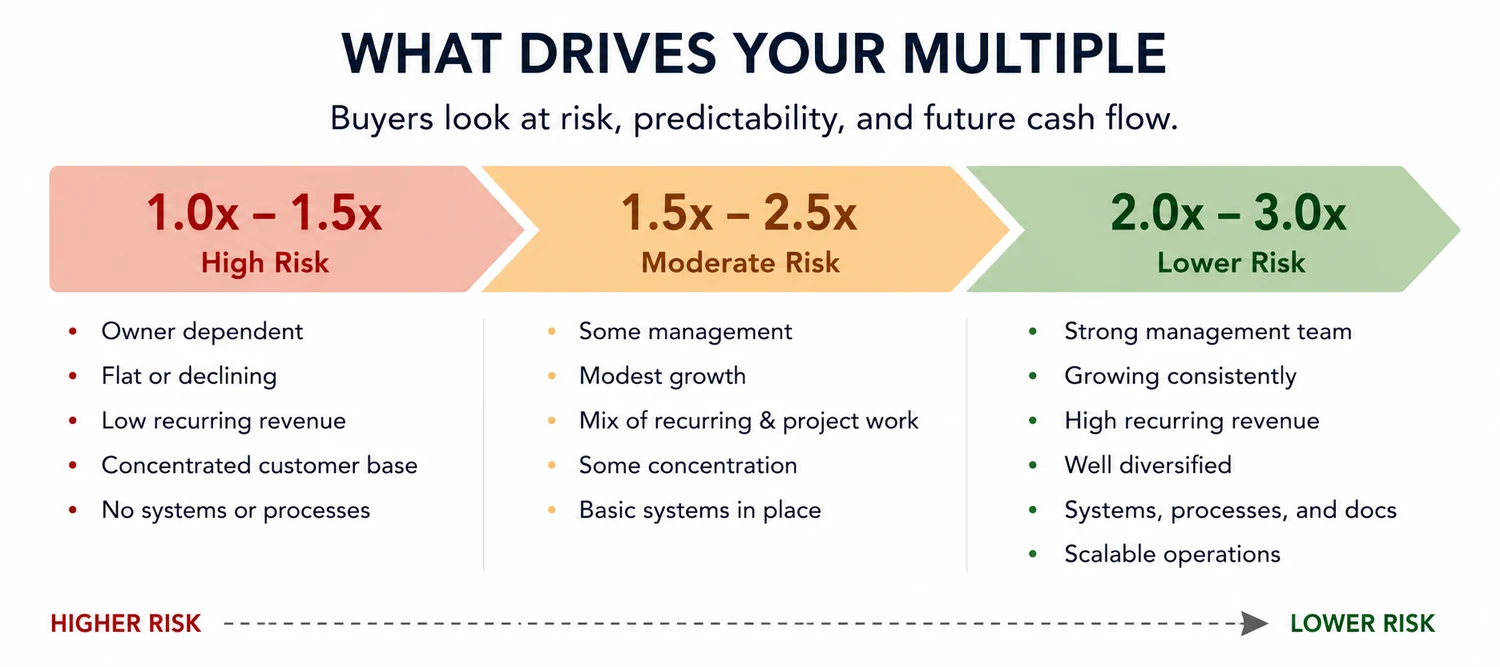
A handful of factors drive buyer confidence more than anything else, and none of them change what the business earns today. They change how believable it is that it keeps earning tomorrow.
Owner dependence is the biggest. If everything runs through you, the day you leave takes a lot of the business with it. A capable management team, documented systems, and clear procedures give a new owner confidence they’ll be able to run the business once you’ve left.
Recurring revenue has a similar impact, because a buyer can count on it where one-time or project work they can’t.
Customer concentration cuts the other way: $200,000 across hundreds of steady clients is far safer than the same $200,000 from three big accounts, where losing one caves in the earnings.
Clean books, documented procedures, lead-source tracking, and a proven commercial platform instead of a homegrown management system all give a new owner more peace of mind.
Scale belongs here too, and it’s where smaller owners most often misunderstand how buyers apply value. Some of it is obvious: bigger businesses are more proven and less dependent on any one person. But there’s a deeper reason, and in this industry it starts with revenue. Around $1 million in revenue is a good sign that a business can support a real management team. Say I want to reach that scale in a market. I can buy one business that already has the management team in place, or I can buy several smaller ones and stitch them together, aligning them, integrating their systems, and building a management team over time. That path takes time and carries real operational risk. That’s why a business already at scale is worth more per dollar of earnings, and earns a higher multiple, than a smaller business at the same margin.
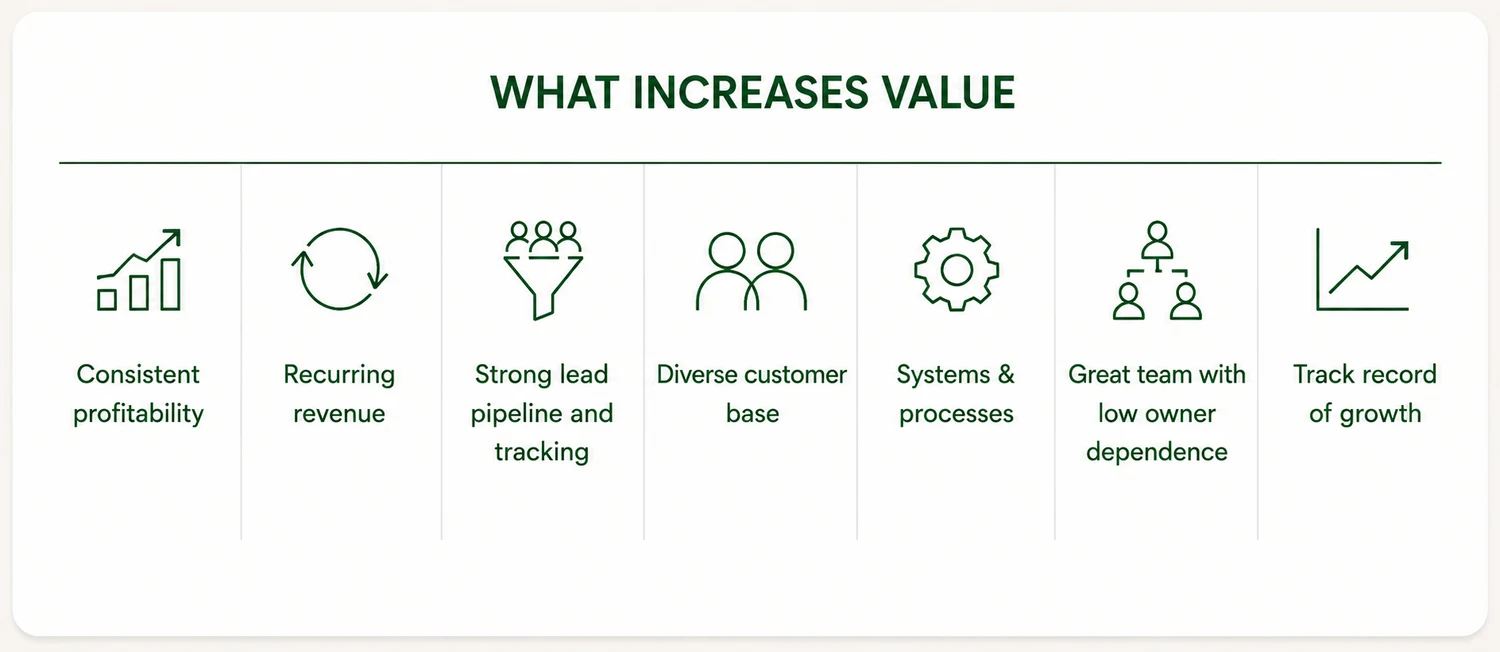
Every item on that list does one thing: it turns your economics from a story the buyer takes on faith into something they can believe will outlast you. That’s what they’re paying for: not the systems themselves, but the confidence the systems buy.
There’s a comparison that makes this concrete, and you already understand it, because you’ve been the buyer. Two houses on the same street, same square footage, same floor plan. One is move-in ready; the other needs a roof, a kitchen, and who knows what behind the walls. They don’t sell for the same price, and nobody’s confused about why. You pay more for the finished house not for more rooms, but to avoid uncertainty.
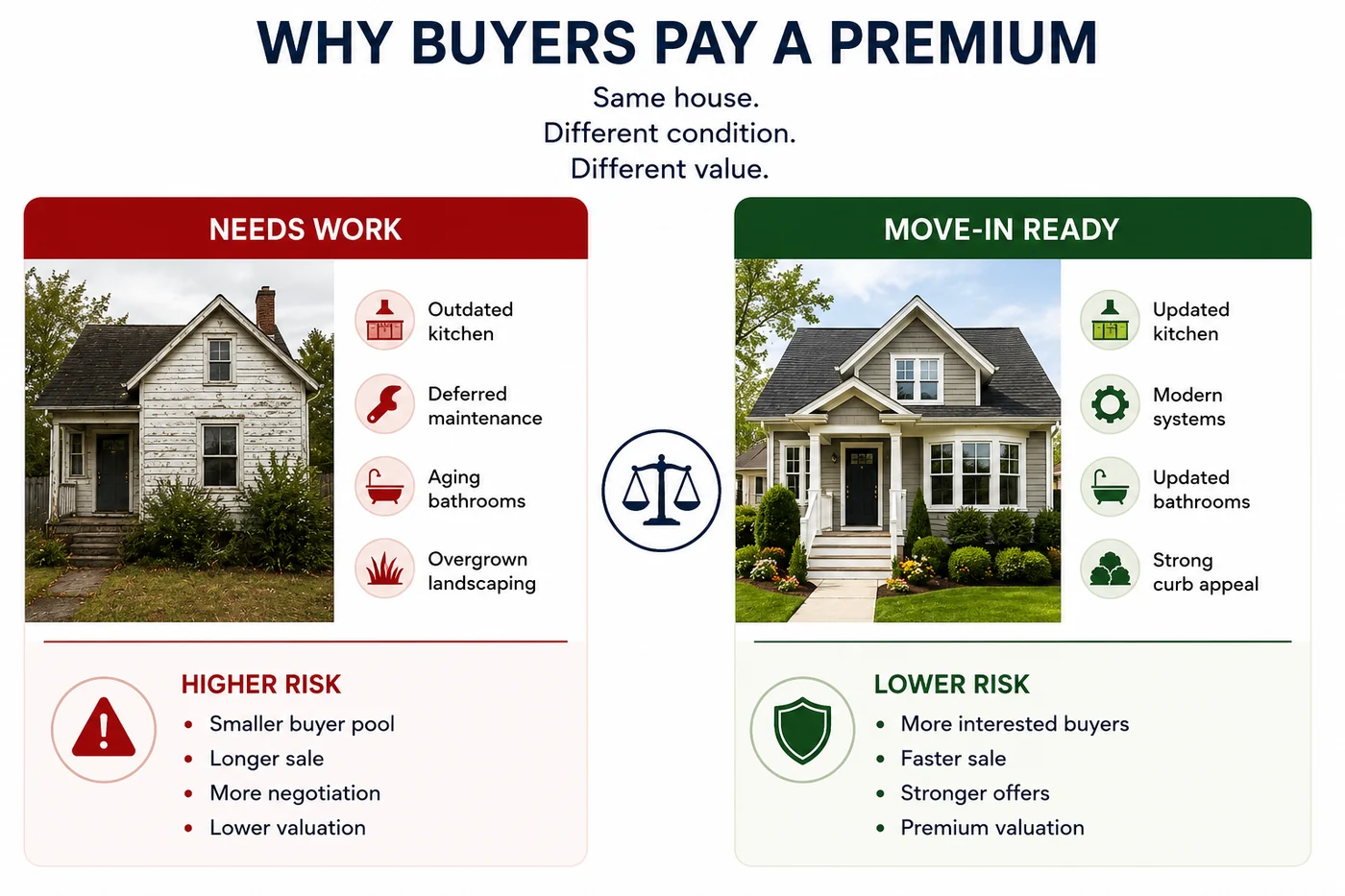
A business is no different. A move-in-ready business, with systems in place, a team that stays, and revenue you can count on, is considered “turn key” and commands a premium, just like a move-in-ready home. The economics can match the fixer-upper next door. The confidence doesn’t.
All of this applies to almost any service business, but how hard the two questions swing depends on what kind you run. Pet care is a near-perfect illustration, because the term “service business” covers a broad range of businesses with very different multiples.
A disclaimer first: the home-services end of pet care is exactly what we acquire and operate, so it’s fair if you read what follows with a raised eyebrow. We’d still rather give you the real math and an honest look at how we assess the industry.
Picture a daycare or boarding facility. Every client comes to you, the front desk knows each dog by name, and the client’s loyalty is mostly tied to the location. If a staff member leaves, the customers stay, because the relationship is with the place; some might even say convenience is the primary relationship. Add real estate and recurring on-site bookings, and the answers to the confidence question look really strong: the facility is a financeable asset, and the customer base is sticky. These earn the higher multiples in pet care, and veterinary practices sit higher still, thanks to licensing, barriers to entry, and years of private-equity consolidation.
Now picture a dog-walking company doing a million dollars a year. The economics can be very good, but the confidence question gets harder. At that size, the owner has never met most of the clients; each client’s primary relationship is with their walker. During a transition, there’s a risk a walker decides to try servicing their clients directly, and there’s no front desk or lease holding them in place, just goodwill that lives with an individual and the business. Sellers can strengthen their position by putting non-solicits in place with all their staff, and non-competes where they’re enforceable. And while Houndry, as any buyer should, works to enforce and protect the client value it acquires after closing, pursuing “theft of clients” still takes time and resources, so that risk sits with the buyer. That’s why the market prices these more conservatively than businesses with tangible assets. It has happened more than once that this kind of business is sold, only for the buyer to struggle to run it and sell it again shortly after. We take them on because we operate them every day and understand the nuance, but the industry has a lot of nuance that isn’t intuitive, so it isn’t the right fit for every buyer.
Here’s the part worth holding onto. The things that lower confidence, owner dependence and relationships that live with a single walker, are the things you can fix. Build the systems, the brand, the back office, and the bench of people, and you don’t just make the business easier to sell someday. You also make it more valuable to you while you still own it. And that’s the same advice we’d give an owner who never plans to sell.
Come back to where we started. Two businesses, the same $200,000 in earnings, one worth 50% more. By now, the answer should feel obvious. Business B didn’t sell for more because its EBITDA was different. It sold for more because its economics were stronger, and because the buyer was far more confident those economics would survive the handoff.
So, what’s your business worth? It’s a function of how strong your economics are and how confident a buyer is that they’ll continue. As a benchmark, a healthy home-services business doing around $1 million in revenue is generally looking at a 3x EBITDA multiple. Higher confidence can push that multiple up a little; lower confidence can pull it down a lot.
It’s worth remembering what that number represents. For many owners, these sales are a significant return on years of work, and the means to pursue whatever comes next, whether that’s retirement, more time with family, or another passion. We’ve completed many of these types of deals, and this is where we’ve found good alignment: it balances an owner’s move to their next chapter with our ability to step in and carry the business, and its legacy, forward. It’s generally an excellent outcome for everyone.
When someone buys your business, they aren’t buying your financial statements. They’re buying confidence: that the customers stay, the employees stay, the systems keep working, and the engine keeps running long after you’ve handed over the keys.
That’s why the owners who earn the highest valuations spend years on both halves at once: making the economics stronger and a buyer more certain they’ll last. So the most useful question isn’t “what is my business worth today?” It’s “how do I build a stronger engine, and how do I make a buyer confident it runs without me?” Improve those two things, and the multiple will follow.
Our previous article gets practical about exactly that: what to focus on to grow your business, or prepare it for a sale well in advance.

We'd be happy to spend 30 minutes sharing how professional buyers would likely evaluate your business, even if you have no intention of selling anytime soon.
Contact us